
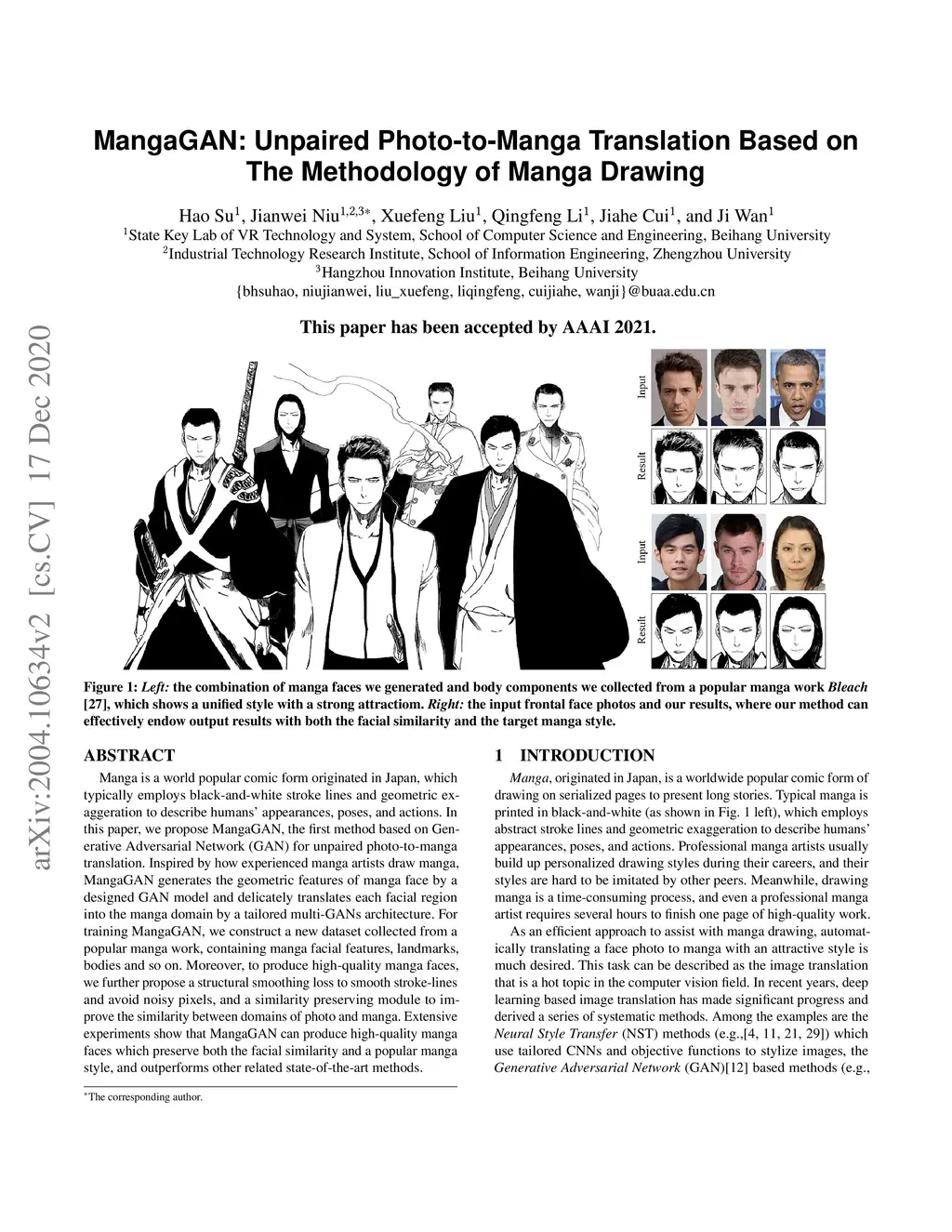
Manga is a world popular comic form originated in Japan, which typically employs black-and-white stroke lines and geometric exaggeration to describe humans' appearances, poses, and actions. In this paper, we propose MangaGAN, the first method based on Generative Adversarial Network (GAN) for unpaired photo-to-manga translation. Inspired by how experienced manga artists draw manga, MangaGAN generates the geometric features of manga face by a designed GAN model and delicately translates each facial region into the manga domain by a tailored multi-GANs architecture. For training MangaGAN, we construct a new dataset collected from a popular manga work, containing manga facial features, landmarks, bodies, and so on. Moreover, to produce high-quality manga faces, we further propose a structural smoothing loss to smooth stroke-lines and avoid noisy pixels, and a similarity preserving module to improve the similarity between domains of photo and manga. Extensive experiments show that MangaGAN can produce high-quality manga faces which preserve both the facial similarity and a popular manga style, and outperforms other related state-of-the-art methods.
View on arXiv