
Federated Over-the-Air Subspace Learning and Tracking from Incomplete
Data
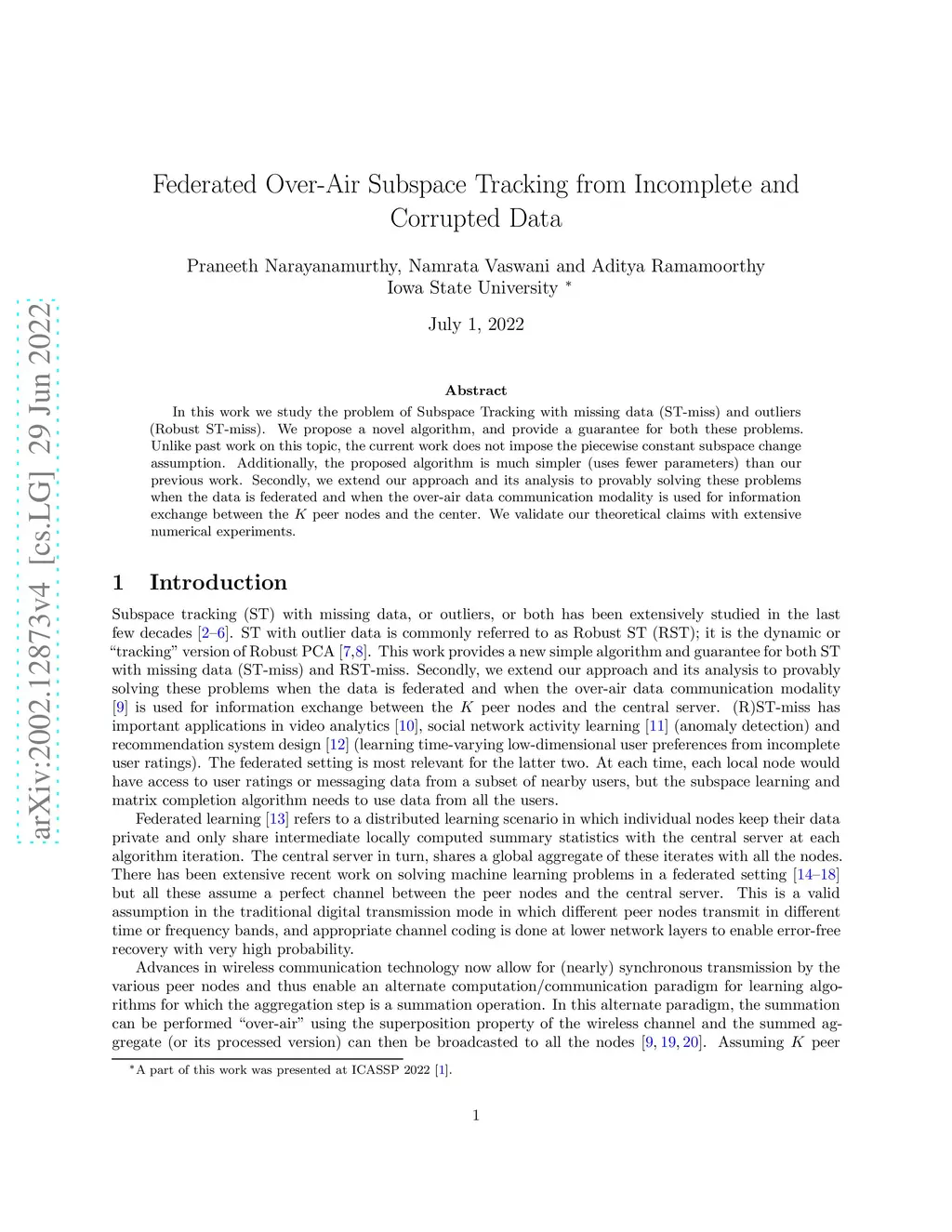
We consider a federated learning scenario where peer nodes communicate with a master node via a wireless channel using the newly developed ``over-the-air'' superposition and broadcast paradigm. This means that (i) data transmitted from the nodes is directly summed at the master node using the superposition property of the wireless channel; and (ii) the master broadcasts this sum, or a processed version of it, to all the nodes. The implicit assumption here is that the aggregation to be performed at the master node is an additive operation. This new transmission mode is enabled by advances in wireless technology that allow for synchronous transmission by the peer nodes. It is times time- or bandwidth- efficient compared to the traditional digital transmission mode, but the tradeoff is that channel noise corrupts each iterate of the underlying ML algorithm being implemented. Additive noise in each algorithm iterate is a completely different type of perturbation than noise or outliers in the observed data. It introduces a novel set of challenges that have not been previously explored in the literature. In this work, we develop and analyze federated over-the-air solutions to two well-studied problems in unsupervised learning: (i) subspace learning and (ii) subspace tracking from incomplete data.
View on arXiv