
Estimation and Inference about Conditional Average Treatment Effect and
Other Structural Functions
- CML
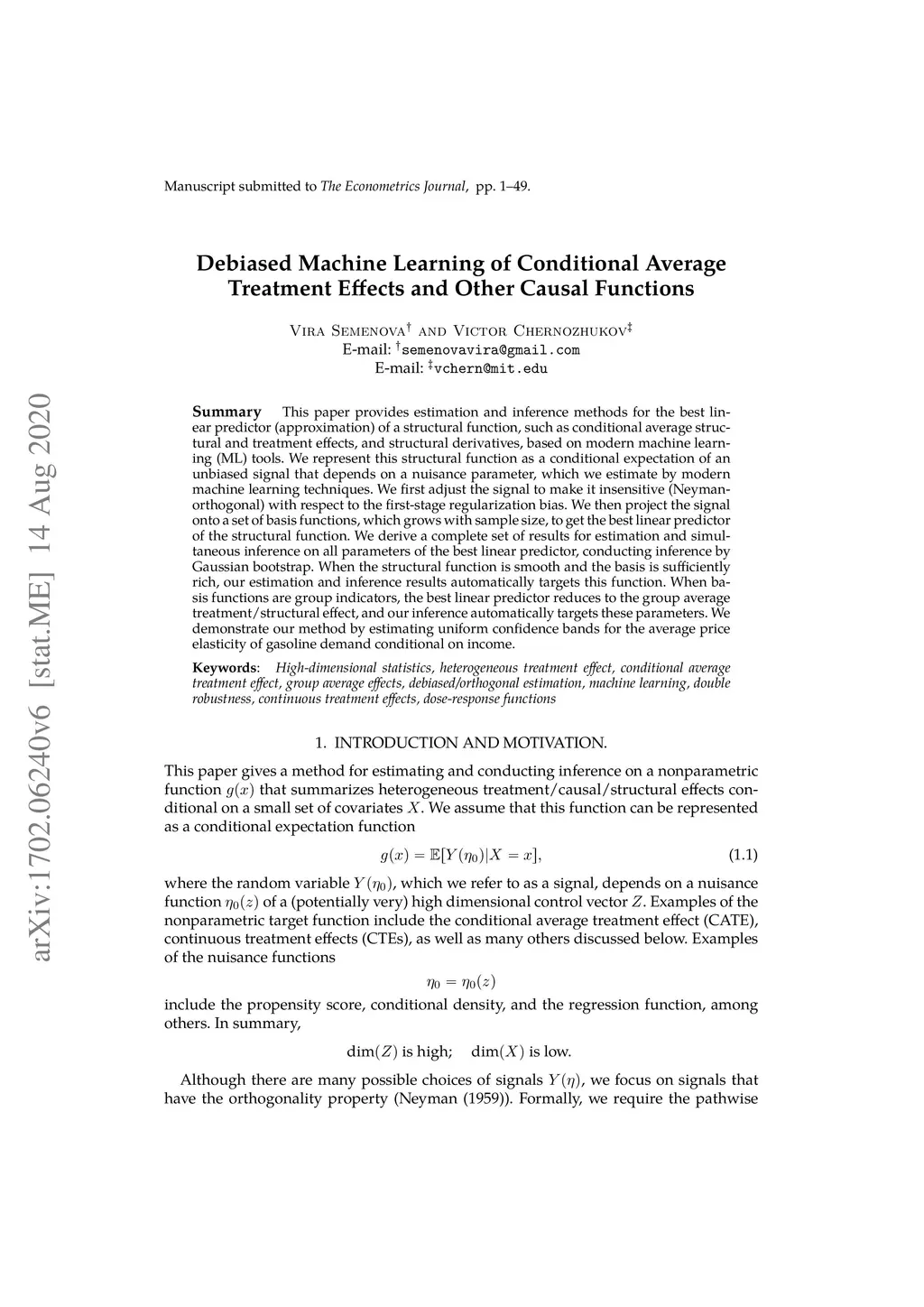
Our framework can be viewed as inference on low-dimensional nonparametric functions in the presence of high-dimensional nuisance function (where dimensionality refers to the number of covariates). Specifically, we consider the setting where we have a signal that is an unbiased predictor of causal/structural objects like treatment effect, structural derivative, outcome given treatment, and others, conditional on a set of very high dimensional controls . We are interested in simpler lower-dimensional nonparametric summaries of , namely conditional on a low-dimensional subset of covariates . The signal depends on an unknown nuisance function . In the first stage, we need to learn the function using any machine learning method that is able to approximate accurately under very high dimensionality of . For example, under approximate sparsity with respect to a dictionary, -penalized methods can be used; in others, tools such as deep neural networks can be used. To make the subsequent inference valid, we make the signal orthogonal to perturbations of . As a result, the second-stage low-dimensional nonparametric inference enjoys the quasi-oracle properties, as if we knew . In the second stage, we approximate the target function by a linear form , where is the Best Linear Predictor parameter. We develop a complete set of results about estimation and approximately Gaussian inference on and . If is sufficiently rich and admits a good approximation, then gets automatically targeted by the inference; otherwise, the best linear approximation to gets targeted. When is specified as a collection of group indicators, describes group-average treatment effects (GATEs).
View on arXiv