
The Future of Scientific Simulations: from Artificial Life to Artificial
Cosmogenesis
- AI4CE
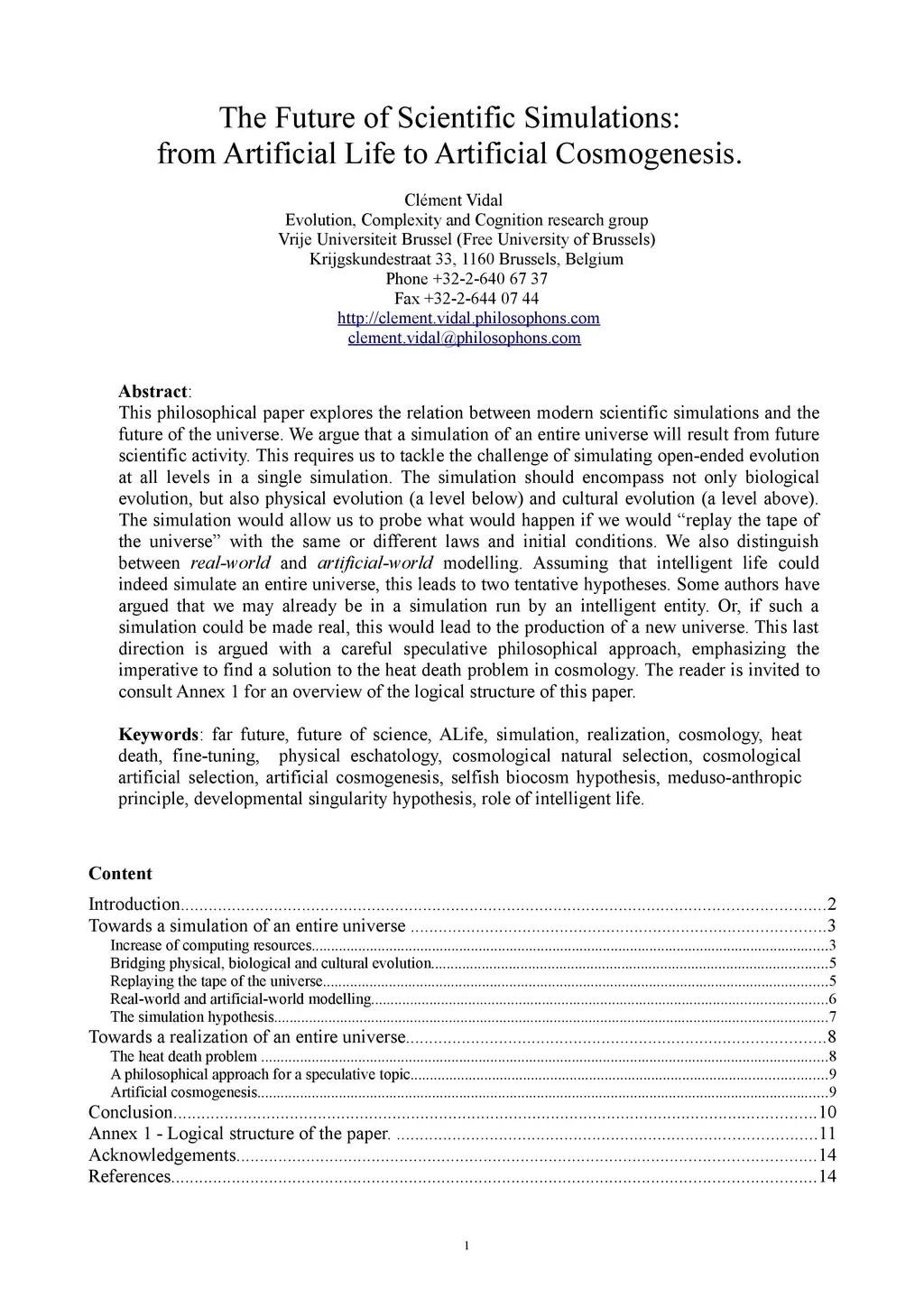
This philosophical paper tackles the question of the future of simulations in science from a cosmic viewpoint. We argue that it will result in a simulation of an entire universe. This requires to tackle the challenge of simulating open-ended evolution at all levels in a single simulation. The simulation should encompass not only biological evolution, but also physical evolution (a level below) and cultural evolution (a level above). The simulation would allow to probe what would happen if we would "replay the tape of the universe". The status of an entire universe simulation is discussed distinguishing between real-world and artificial-world modelling. Assuming that intelligent life could indeed simulate an entire universe, this leads to two tentative hypotheses. Some authors argued that we could be in a simulation run by an intelligent entity. Or, if this simulation could be realized, this would lead to an artificial cosmogenesis. This last direction is argued with a careful speculative philosophical approach, emphasizing the imperative to find a solution to the heat death problem in cosmology. The reader is invited to consult Annex 1 for an overview of the logical structure of this paper. Keywords: far future, future of science, ALife, simulation, realization, cosmology, heat death, fine-tuning, physical eschatology, cosmological natural selection, cosmological artificial selection, artificial cosmogenesis, selfish biocosm hypothesis, meduso-anthropic principle, developmental singularity hypothesis, role of intelligent life.
View on arXiv